
Witnesses of great loss and hope
Published: Feb 25, 2026 Reading time: 6 minutes Share: Share an articleFour years ago, people, frightened by explosions, hurriedly packed belongings; many focused on basic essentials and small items of sentimental value in the belief they would return soon. But for many, it was the last time they saw their home.
Through invisible threads, those small items, tucked between clothes and the flotsam of daily life, now connect families to the places they still call the happiest on earth.
We continue to share stories about people and the objects that symbolise home. About the incredible strength to move forward. About the courage to begin again.
On the fourth anniversary of Russia’s full-scale invasion of Ukraine, we honour the memory of those who were killed, those who remain, and those whose lives have been changed by the war.
Paints that helped to start from scratch
In a car hastily leaving occupied Berdiansk, several people were evacuating their belongings and pets. There was so little space, they agreed to take only the most valuable things. Maryna took her paints. In two boxes she fit her entire former life—and everything she needed to begin again.
“Then came hand-painted cups, teapots, toys. At the heart of my business is the idea of transforming ordinary objects into sources of light, harmony, and beauty in everyday life,” she says.
Support from the American people helped us sustain Maryna’s relocated business. Symbolically, it was from the United States that Maryna received her first international order—a set of glasses decorated with poppies.

An address that cannot be erased from memory
In spring 2022, Anastasiia a doctor was forced to leave her hometown of Vovchansk. Although some of her expensive medical equipment was evacuated after the city was liberated, her clinic was completely destroyed. So, her team had to start over from scratch. They opened their first new facility in the centre of Kharkiv and later expanded to another location. Today, Anastasiia still keeps the business card from her very first clinic.
“Here is my surname and our first address. The place itself is practically gone, but the business card remains. It reminds me of the entire journey we’ve been through,” the doctor shares.
Today, the new clinic—symbolically named “Ridni” (“Dear Ones” or “Those Close to Us”)—serves around 7,000 patients. Through a grant project supported by the American people, we helped Anastasiia purchase a specialised vaccine refrigerator. This can maintain the required temperature for up to three days, even during prolonged power outages.

Home is where the stove works
For some, home is four walls. For Vasyl, it is his dog Lyusya, a few chickens, and the chainsaw he took with him when leaving Shevchenkove in Sumy Oblast, just two kilometres from the Russian border. After constant shelling and destroyed houses, he eventually relocated to Bohodukhiv in Kharkiv Oblast.
“The chickens on the back seat, Lyusya in my arms—and off we went,” recalls this intrepid 69-year-old man, who in 1986 covered the reactor at the Chornobyl Nuclear Power Plant.
The cold season in Ukraine is long—the stove works from November through March. With the support of the European Union, we provided Vasyl with cash to buy fuel. He managed to order a truckload of firewood before the heavy snowfalls. His current home will be warm. And as for the firewood, Vasyl will handle it himself—his chainsaw is always ready.

“Every spring I go home”
Liudmyla’s room is impeccably tidy. Everything is in its place, and the windowsill is filled with potted plants. She does everything she can to create comfort and warmth, so that the dormitory feels as close as possible to her home in Kharkiv Oblast.
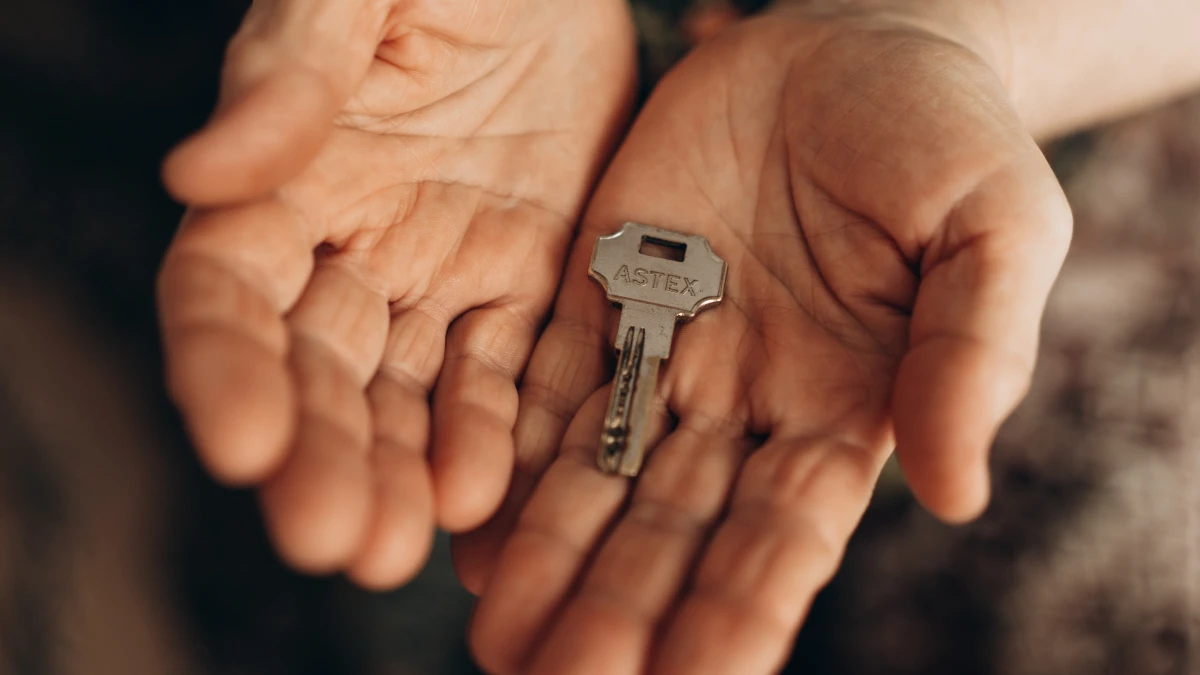
She shows us the small bag she hurriedly packed back then: slippers, underwear, clothes—and the most precious thing she brought with her, a portrait of her late son Denys. This photograph, along with the house key she still keeps in her wallet—these are the thin threads that connect her to home.
“Every spring I think about going back. But I know that if I go, I might never return. Recently, a drone hit a house—three small children and their father were killed. I knew Hryhorii. He was from my village and had recently bought a house in Bohodukhiv to be farther from the border. It’s only 15 kilometres away,” she says sadly.
Today, Liudmyla’s room has been renovated, but her first days in the dormitory were difficult. Families lived in cramped conditions, and the building was old and worn out. Together with the Czech people, we have supported this collective centre since the first days of the war—providing hygiene kits, household appliances, and repairs.

What remains after the ruins
Serhii is a retired combat veteran. Yet even with his experience, the events in his hometown of Vovchansk came as a shock.
“I never heard anything like that even in Afghanistan. We stayed in the cellar until six in the morning and didn’t come out. When I ran outside, there was no fence, no neighbours. Everything had burned down,” he recalls.
When he was forced to leave, he took almost no clothes or personal belongings with him. He says that, in that moment, he simply “switched off.” All that remained of his former life were the keys to his daughter’s destroyed home and his pets, Muska his cat and Lola his turtle.
Today, four people share a single apartment in Kharkiv. Serhii and his wife, their daughter, and their granddaughter. Rent and utilities are expensive. They pay up to 7,000 hryvnias per month for utilities alone.
With funding from the Swedish government, we helped Serhii’s family pay their utility bills. This helped get them through the coldest months, when Lola was constantly searching for a warm spot near the radiator.

Family recipes for survival
At first glance, it is an ordinary family photo against a patterned carpet. A mother and daughter in matching dresses. Oksana had sewn them specially for that photoshoot of their happy family. She took this picture from her home in Mariupol—a quiet reminder of life before the war. But one person in this photo is no longer alive. Oksana’s husband Ihor, he went through the dual-hells of Azovstal and captivity, and later returned to the Armed Forces.
“Ihor never even considered not going back to the army. But he told the guys that if things became a little easier at the front, he would like to leave the service and do something else. We wanted to open a small bakery. It was his dream,” she says, her voice filled with pain.
Oksana had always known how to bake—buns, cakes, and other sweet treats. But to open her own bakery, the engineer by training had to learn a great deal. As the wife of a fallen defender, she joined our veteran support project “Courage to Business,” from which she received a grant.
The premises, equipment, furniture, coffee machine—everything is already in place. All that remains is to connect the utilities, and the bakery shop with the meaningful name “Dubyk Family Recipes” will open its doors.


