
The Notebook Of Longevity: A history of social support beyond the pages
Published: Dec 3, 2025 Reading time: 5 minutes Share: Share an articleIn Zaporizhzhia, home-based social support helps people to resume normal life after evacuation, shelling, or through deteriorating health. Through our Notebook Of Longevity project, we, and the Angels of Salvation, support elderly and vulnerable residents affected by the war.
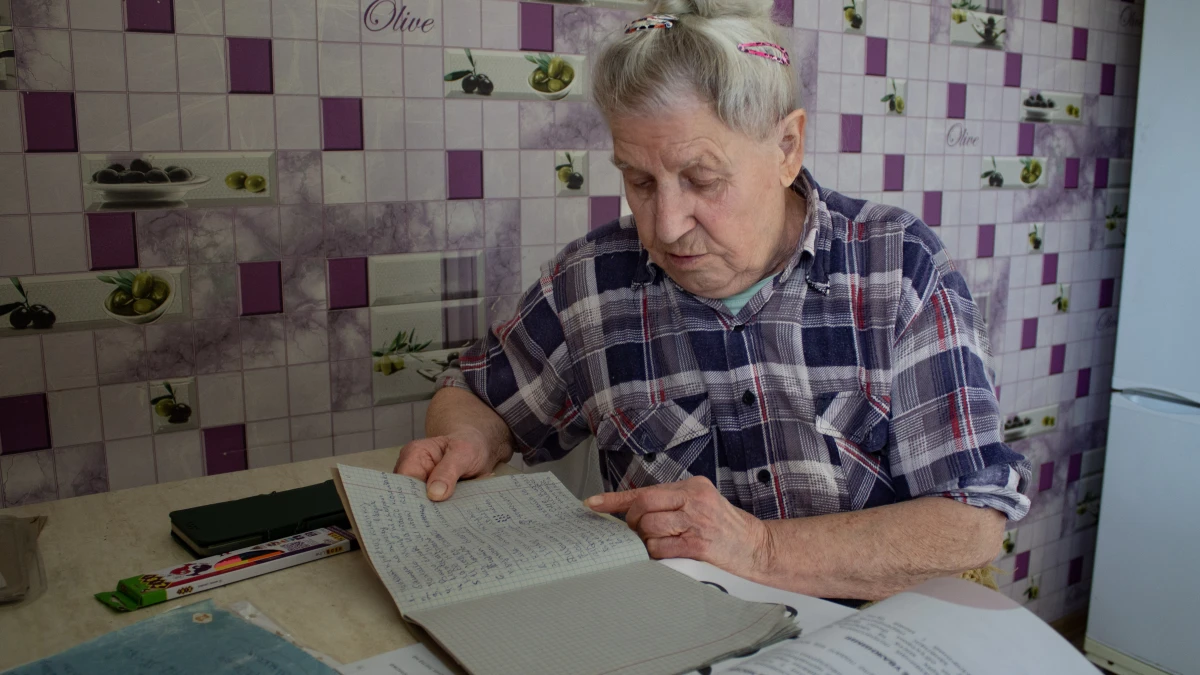
A small bell hangs on the handle of Valentyna's front door. It appeared after medics accidentally locked her in her apartment and left the key outside. Now the bell is her insurance.
She is 84 years old. She has a shrapnel fragment in her body—a bitter reminder of the Second World War. When she was two years old, she survived shelling that left her with a concussion, severe headaches and damaged vision in one eye. Although her health is failing, she is holding on. As a woman who once managed dozens of factory workers, worked in harsh northern conditions, and undertook sea voyages she does not give up.
“I am still energetic, even though I only have one eye. But lately, I can't keep up with everything,” she says.

Valentyna lived in Orikhiv when Russia's full-scale invasion of Ukraine began. But when the streets she had known since childhood began to be wiped off the face of the earth, she was horrified by the realisation that she could not stay.
“I went to get an X-ray of my broken arm, and then the hospital came under fire. Five dogs ran up to me in fear. They lay down on their bellies and froze like an explosion, and I did the same. That's how we survived. Then some men came up to us and said, 'Get on the bus, or you'll be dead.' That's how I ended up in Zaporizhzhia,” Valentyna recalls.
Since then, she has moved twice because her previous apartment was bombed too. However, no matter where she lives, her situation as a pensioner hardly changes. After paying the rent and utility bills, she has to buy food and medicine. She has less than $12 left to cover these expenses. So, any help is important.
Valentyna is happy to welcome new guests. When Nataliya, a social worker, came to help her with the housework for the first time she was thrilled.

This work is familiar Nataliia. In recent years, she has performed similar tasks at a state institution in a neighbouring community.
“Every day, I visit three people in my care. They all have health problems and are elderly, and they have all been forced to leave their homes. I feel so sorry for them, for being left without a place to live,” says Nataliia.

Nataliia and Valentyna are participating in the Notebook Of Longevity project, which involves providing social support to elderly people in Zaporizhzhia and assistance to evacuees in the Dnipropetrovsk and Donetsk oblasts. We are cooperating with the Angels of Salvation and with financial support from the Czech people. We have already assisted about 900 people at home and another 5,000 in transit centres.
“This project is about people, their needs and practical support. We were also looking for a special component in the field of psychology. That's how the Notebook of Longevity came about. It is a simple workbook that the psychosocial support team developed as a tool for working with anxiety, memory, and daily habits,” says Olena Myronenko, Senior Protection Officer at People in Need.

Yuliia Nykyforenko, another social worker on the project, believes that the most important thing in this work is a human approach.
“Of course, social education is necessary, but what is most important is humanity,” says Yuliia. “Pensioners are all different. Some smile, some are reserved. But if you are interested in the person, not just ticking a box on a report, you can connect. And part of our communication is facilitated by this Notebook of Longevity.”
Yuliia has 15 clients. Every day, she visits three people in different parts of the community. She is driven part of the way and walks the rest. Her work is not limited to “bringing and buying”. It also includes cleaning, conversation, and completing the Notebook of Longevity together.
“Not everyone wants to work on it,” Yuliia smiles. “Some say, “Why do I need these exercises?”. But there are grandmothers and grandfathers who do them for peace of mind. It's also a way to organise your thoughts.”

Yuliia speaks particularly warmly about her ward Tetiana: “She is so soulful. You could write a book about her life and listen to her for hours. The street where she lives is named after her grandfather. He built Zaporizhzhia. Tetiana Petrivna knows everything about him. She doesn't ask for anything extra and is grateful for every little thing.”
Tetiana’s freedom of movement is curtailed by crutches, a wheelchair, and a walking stick. So, Yuliia helps her do things that requires active movement: from going to the shops to washing windows.
"We are not talking about thousands, but tens of thousands of people who have no one to rely on. In communities, these are often elderly people who live alone. Some have no relatives at all, or all of whom have long since moved abroad. Many have neither the health nor the transport to get to the community centre," says Taras Kravets, project manager at Angels of Salvation.
Part of the team's work is to help in transit centres for evacuees. In these places, the importance of being close to people is particularly evident.
Every year, International Day of Persons with Disabilities reminds us of human rights standards: accessible buildings, inclusive education, adapted transport. All of this is critically important. But there is another, less visible part of this reality—everyday relationships and support. Today, much depends on them.


