
For some children, the school day begins with a descent into an underground classroom. Others go to their usual classrooms, where lessons can be interrupted at any moment by air-raid sirens. Still others join lessons from home, struggling to stay connected during power cuts or internet disruptions.
The war has changed school life for millions of Ukrainian children. Yet despite these challenges, they continue to learn, make friends, discover new things and plan for the future. To mark World Children’s Day on 20 November, we share stories of children learning in three different settings and highlight their right to safe, accessible education.
Sofiia is 16 years old. She was born and raised in Zlatopil in Kharkiv region and is currently in Year 11. When the full-scale invasion began, an explosion occurred near her home. It was frightening, but, as Sofiia explains, she and those around her have sadly grown accustomed to such experiences.
School life changed too. Some of her friends left the city, and lessons moved online. Her class, which once had around 30 pupils, now has just 16.
“Many of my friends have left. Some went to Poland, others to Canada. But I’m still in touch with one friend who’s in Canada now,” says Sofiia.
This year, an underground school opened in the city. For Sofiia, this meant returning to face-to-face learning, seeing her classmates again and continuing lessons during air-raid alerts. This is particularly important now, as she prepares for her final exams.
“I was pleased that there wouldn’t be any more distance learning. It’s so stressful – lessons get cancelled, or something else happens. But here, lessons are continuing, and we’re catching up on the material we need, especially for the exams,” she explains.
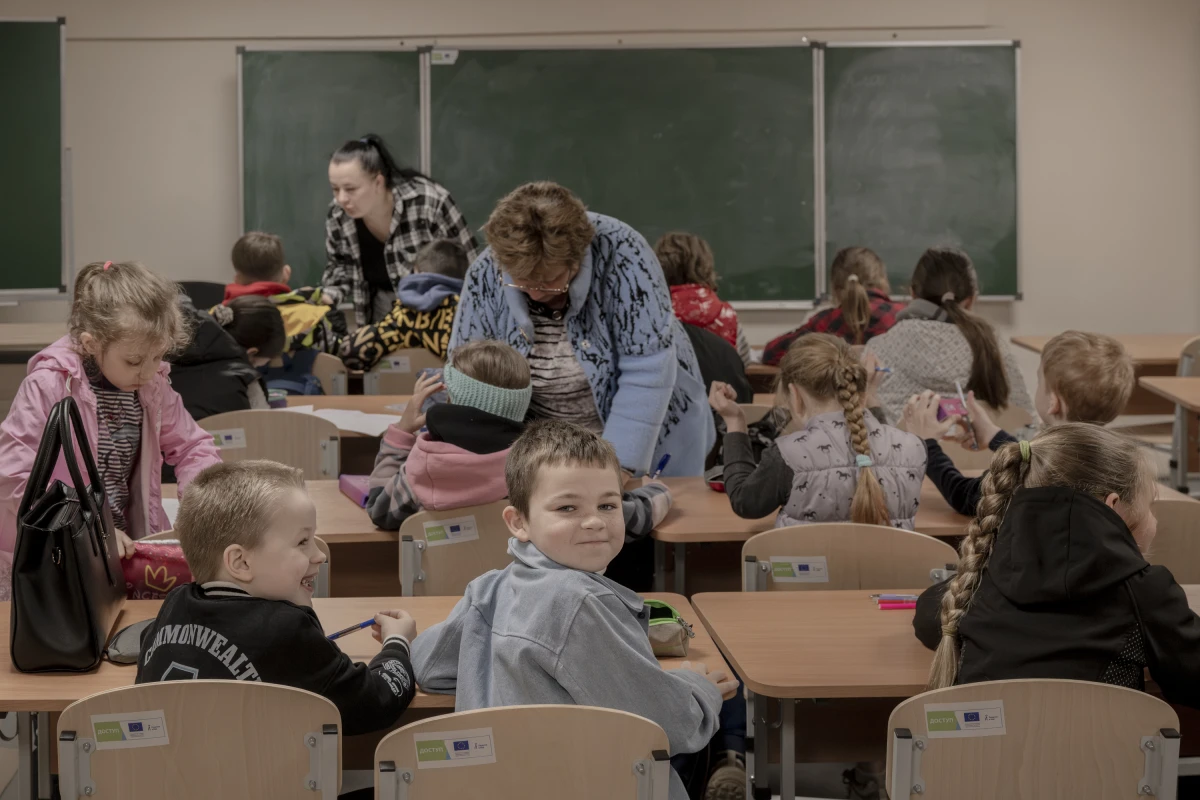
For children in communities across Kharkiv region, where Russian shelling is a regular occurrence, underground schools and sheltered learning spaces offer an opportunity to return to face-to-face learning. Children can interact with teachers and classmates and continue their lessons even during air-raid alerts.
Kira and Serafima are both eight years old. They are in Year 3 at Novomykolaivka Lyceum. Their school day is spent either in a regular classroom or in a shelter, depending on whether an air-raid siren sounds.

The girls say that air-raid alerts occur almost every day. They already know exactly what to do when they hear the siren:
“Grab your backpack, go to the shelter and sit down to study. After lessons, we can go to the after-school club.”
If Kira and Serafima could choose between face-to-face and distance learning, they would probably opt for online learning. Not because they dislike school, but because they would not have to keep moving to the school shelter. Yet they enjoy seeing their friends at school, going for walks during breaks and spending time together after lessons.
According to the Ministry of Education and Science of Ukraine, as of the end of October 2026, approximately 90 per cent of schools were providing face-to-face or blended learning. However, not all schools have shelters suitable for teaching. Whether lessons can continue there depends on the layout and facilities available.
Shelling is one of the few memories Ivan has of his home town of New York in Donetsk region. On one occasion, a shell landed about 30 metres from the family’s house. After that, Kateryna and her husband decided to leave, primarily for the safety of their sons. The family now lives in Dnipro.

Ivan and his older brother Bohdan continue to attend their home town school online, which allows them to stay in touch with their friends. Lessons follow a regular timetable, and the family looks for ways to stay connected despite air-raid alerts, power cuts and internet disruptions.
“I know they’re safe. They’re studying, and gaining knowledge. If I’m not at home, they know the ‘two-wall rule’: they move into the corridor, away from the windows. And when there’s heavy shelling, they go down to the basement under the building. The internet works there too, so they can continue studying,” says Kateryna.
For many Ukrainian children, distance learning remains the only way to continue their education. According to UNICEF, nearly one million children in Ukraine were studying online in November 2025.
According to the Ministry of Education and Science of Ukraine, since the start of the full-scale war, 4,706 educational institutions have been damaged by Russian shelling, including 428 that have been completely destroyed.
As attacks across the country intensify, safe, well-equipped learning spaces and school shelters are essential to helping children continue their education during air-raid alerts.
During the 2025–2026 academic year, our team at People in Need renovated and equipped temporary learning spaces in 24 educational institutions, enabling more than 10,000 pupils to continue their studies in these spaces. We also organise catch-up classes and provide educational support to help pupils recover learning lost due to interruptions in their education.
Whether they learn in an underground classroom, a regular school or at home, Ukrainian children face very different circumstances. Yet every child has the same rights to education, safety and development, and the opportunity to enjoy childhood.
Children should not have to choose between safety and education, nor should they have to face the consequences of war on their own. Our task is to help create conditions in which they can continue learning, develop, spend time with their peers and plan for the future.
Education is every child’s right – every day, even in times of war.

Our support for pupils and teachers in Ukraine is made possible through funding from the European Union.


