
The Value of Warmth. Three Stories of Resilience from Kharkiv Oblast
Published: Mar 31, 2026 Reading time: 4 minutes Share: Share an articlePeople in Kharkiv Oblast live under constant attacks which bring anxiety and uncertainty about what tomorrow may bring. Whether they can remain in their homes depends on simple yet essential things: safety, water, electricity, and heat. During this harsh winter, fuel became critical for thousands of families across the region. With the support of the Ukraine Humanitarian Fund, we helped more than 1,500 people and their families get through these cold months.
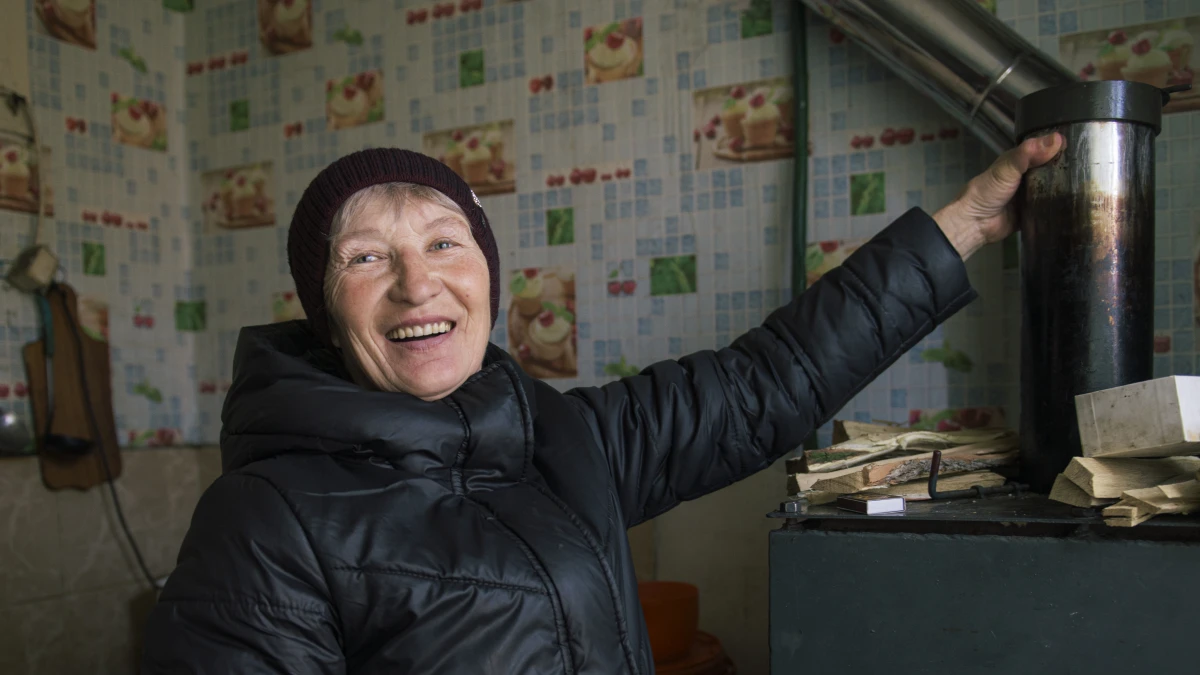
A home where there is always room for one more cat
Among the people we helped this winter are Tetiana, Oleksandra, and Mariia.
When Tetiana worked in Kharkiv, she had to walk seven kilometres every day to catch the train. One day, she saw a cat that had been abandoned to freeze. She picked it up and took it home.
“I felt sorry for the poor thing. Where else could it go?” she says.

Tetiana has lived in Peremoha, Kharkiv Oblast, since 1994. Some of her neighbours have left, and in nearby homes, windows are shattered by explosions. Heating her home is difficult. No matter how much firewood she puts into the stove, the temperature never rises above 18°C. Last year, she installed a solid fuel boiler, which she now relies on heavily.
“It fits about one and a half sacks of firewood at a time. I light it once, and it burns until evening,” Tetiana says.

As she shows us the stacked firewood near her shed, we can hear Russian drones overhead. When they are shot down, she barely reacts.
“There’s no time to pay attention to explosions. They happen several times a day here,” she says matter-of-factly.
She has too many other things to do: carry firewood, feed the boiler, take care of the cats, and fetch water from the well. Her adult children live elsewhere. She could move in with them, but that would mean leaving her home—and her cats.
“And where would I leave them?” she says.

A winter to get through for the sake of the children
More than two years ago, Oleksandra and her family lost their home due to shelling and were forced to relocate. They moved several times, trying to find a place where they could get through the winter. Eventually, they settled in Skovorodynivka.
The house had only a stove, so the fuel briquettes they received were ideal for her needs.
“The briquettes you brought us lasted the whole winter. Now real warmth is ahead, so we will manage,” says Oleksandra.

Despite the family’s efforts, danger remains close. Recently, shelling destroyed her sister’s house. Her husband and three children were killed.
“It’s very hard… After that, I began to fear for my children. They need a safer place,” she says.
Oleksandra’s eldest child is about to turn six, the youngest is two. Immediately after the tragedy, the family began preparing to move abroad.
A resident of Myru Street in Peremoha
Mariia, originally from Ivano-Frankivsk Oblast, moved to Kharkiv Oblast with her husband Ivan for work. They planned to stay for a year—they stayed for fifty.
“We went where there was work. The director of a state farm offered us a small house and convinced us to stay longer. I like living quietly, in one place. That’s how we settled,” Mariia recalls.

Mariia worked as a milkmaid for thirty years. She is used to physical labour and even now cultivates more than 30 sotkas of land—her own plot and the gardens of neighbours who have left. She grows potatoes, beets, corn, pumpkins—everything needed to feed herself and her livestock.
Her husband Ivan can no longer help as he once did as he had surgery. The entire household now depends on Mariia. Chickens, a dog, and a cow named Krasunia wait for her in the yard. She takes Krasunia out to graze every day.

Work helps them cope, at least partially, with unbearable grief. Their only son joined the military in early 2023 and was killed six months later. For a long time, he was missing, and he was eventually identified through DNA analysis.
“We waited so long… At least now we can visit his grave,” Ivan says.

Alongside their grief, the shelling continues. Drones fly overhead several times a day, and distant explosions tighten the chest. A few months ago, a neighbouring household was destroyed. Recently, drone debris fell under a pear tree in their yard.
“It was almost midnight. There was a huge blast—I looked, and the roof lifted from one side to the other and collapsed. We ran to the door, but it was jammed. We had to break it to get out,” Mariia recalls.
After recovering from the initial shock, they began repairs: replacing windows, fixing the ceiling. They did some work themselves, neighbours helped with some, and for part of it they had to pay. This used up almost all their saavings. And winter was still ahead.

Our cash assistance for fuel was critical, it allowed them to buy firewood, heat their home, and make it through to spring.
Soon, there will be enough warmth again, and Mariia will return to her usual rhythm: the garden, the livestock, the household.
For now, she steps out every day to the small gate on her Myru (Peace) Street and waits for that name to become more than just an address.


