
Stories of Humanitarian Workers in Ukraine
Published: Aug 19, 2026 Reading time: 6 minutes Share: Share an articleThe daily life of a humanitarian worker in Ukraine might involve an evacuations; delivery of food, medicine, water and other essential goods—often under fire; they might also repair homes, schools, and hospitals; and they might even distribute cash to people who need it. This work is essential, but it is also dangerous. Moreover, the danger is increasing.
Between January and July 2026, 10 humanitarian workers were killed in Ukraine. Humanitarian warehouses and service vehicles are also regularly attacked. Among the most recent cases are the killing of two deminers in Kherson Oblast and the destruction of a Kyiv Oblast warehouse holding humanitarian supplies for children. Humanitarian work in Ukraine means daily trips to affected communities, talking with people and working in places where insecurity is the norm.
To get to our team in Zaporizhzhia we must travel on a road covered with anti-drone netting. Standing on ladders, workers stretch new sections into place. Attacks on Zaporizhzhia Oblast have intensified in recent months.
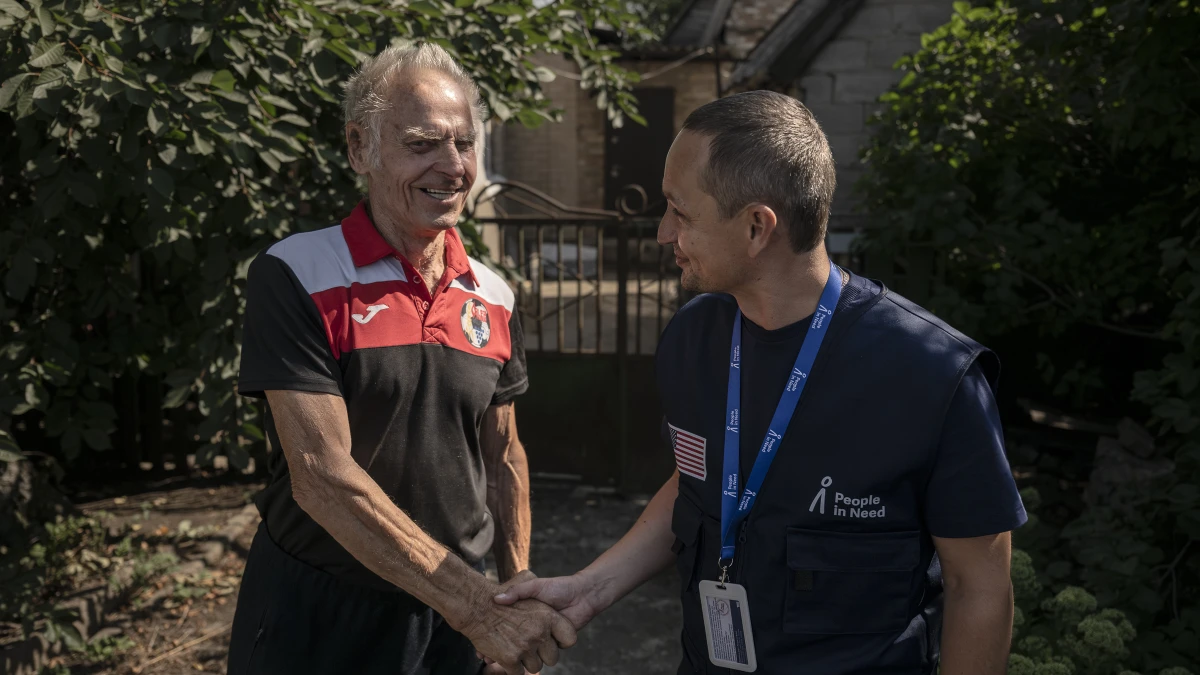
Serhii Popilnukha, Area Coordinator for Zaporizhzhia and Donetsk oblasts, is heading to Vilniansk to meet Yurii Hryhorovych. 87-year-old Yurii had a Shahed drone exploded just 25 metres from his house, smashing all of his windows. We supported the replacement of the windows. Now Serhii is checking whether the repair work was completed properly.

By training, Serhii is a management specialist. He was born in Luhansk Oblast; but he was forced to relocate several times because of the war. He had previous experience in humanitarian work and joined People in Need in 2022.
"The war has changed a lot in recent years. If before we could drive into areas as close as 5 to 10 kilometres from the line of contact and still provide assistance fairly safely, now that's almost impossible because of FPV drones. Nevertheless, we still provide support to people through local authorities and our partners."

Serhii recalls a moment when he was genuinely afraid. In 2023, he was taking measurements in a damaged house in Zaporizhzhia Oblast when an explosion suddenly went off nearby. Together with the homeowner and her two children, he pressed himself against the wall and waited for the danger to pass.
"Like everyone, I hope the war will end soon and that we'll be able to provide not just emergency assistance, but also start rebuilding our country—rebuilding businesses and stable lives for people, both in areas close to the line of contact and across Ukraine."
Because the Derhachi community in Kharkiv Oblast borders Russia it endures constant shelling. Some settlements are subject to mandatory evacuation. Residents who remain need assistance. Anastasiia Steshova, one of our Senior Programme Officer at People in Need, is here to run a registration for vouchers which will take place in a shelter.
Anastasiia joined our team in 2022. She remembers her first working week well. At the time, she was deeply worried about her family, with whom she'd had no contact for almost two weeks.
"Sviatohirsk, where I'm from, was under constant shelling back then. And during the registration, my mother called me. Three shells had hit our house, and sadly, nothing was left. This was how I learned my family was alive! At that moment I understood I had to help people—to encourage them, to reassure them, even as I was trying to calm myself. But I pulled myself together and went back to work."

Anastasiia works in affected communities almost every day. Working with people who are exhausted by constant shelling can be difficult. But Anastasiia tries to give everyone enough attention.
"You try not just to explain our assistance, but to give people attention and support them. I think it's easier for people when you actually talk to them, rather than just saying, 'Here's the assistance, move along.' When you give people enough attention, their mood improves—they become more cheerful, they thank you."

Anastasiia and her family now live in Kharkiv. But she misses her family home in Sviatohirsk deeply, and she grieves for the family photos that were destroyed in the fire.
"I dream of a clear sky, a calm one, so we don't have to be afraid of the sound of planes or explosions. Where we can just look up at a clear sky, be glad that everything's fine, that everyone is alive and well, and that all the bad things are over."
Alona Yemtseva, our Programme Officer for Dnipropetrovsk Oblast, registers residents for vouchers in Pavlohrad. The city is a major humanitarian hub, where many people from destroyed towns and villages have relocated. Registration takes place in a hospital, the same kind of medical facility where Alona began her career.
"I'm a veterinarian by training. Before the full-scale invasion, I worked at a district hospital as head of the anti-epizootic department. But I never thought that helping people in crisis situations would become my calling."

Alona takes every story to heart and admits she's still learning to cope with the emotional weight of talking with people. She's learning to distance herself from what she hears, but knows this work still affects her.
One result of Alona’s ownership her work is that Liubov, from Petropavlivka in Synelnykove district, ended up in her phone's contact list. Liubov had evacuated from Donetsk Oblast and came to the distribution point in the centre of the settlement to receive a hygiene kit.
"She wasn't on the list we'd drawn up in advance with local authorities, but she really needed help. In the end, we gave her a kit. What struck me was that this woman had lost everything, but she hadn't lost her faith in people. She arrived in Petropavlivka with nothing. And she was deeply moved by how the local residents responded—bringing her everything, from dishes to furniture."

Although humanitarian work often takes place in dangerous areas, Alona says she doesn't feel fear. Even during registration in Pavlohrad, our staff and local residents had to run for shelter because of the threat bombing.
"We're always ready for these challenges because we understand that anything can happen—suddenly and unexpectedly," says Alona.
Alona wants to continue supporting people while also looking forward to the day when humanitarian assistance in Ukraine will no longer be critically needed.
"I want peace, for people to live in their own homes, to see their families and loved ones. And I dream of being able to go home myself, to my parents. I want people to believe. Faith is what helps us get out of bed and live this life every day."


