
Getting through winter in Ukraine
Published: Oct 16, 2026 Reading time: 5 minutes Share: Share an articleFor people in Ukraine, winter means more than cold weather. Russian attacks on energy infrastructure are intensifying. Uncertainty about whether they will be able to heat their homes, cook meals or cope with prolonged power cuts adds to the strain of daily life.
We support families in preparing for winter by providing fuel, cash assistance to buy it and kits to help them manage during power cuts. This support helps families stay in their homes and keep warm throughout the winter.
Around 400 people live in the village of Prudy in Sumy Oblast, near the Russian border. Residents are accustomed to the danger, but each new attack is a reminder of the risks of living near the border.
Recently, a Russian drone exploded in the yard of a local home. The homeowner escaped from the damaged house, but her cow was trapped in the shed and burned alive.
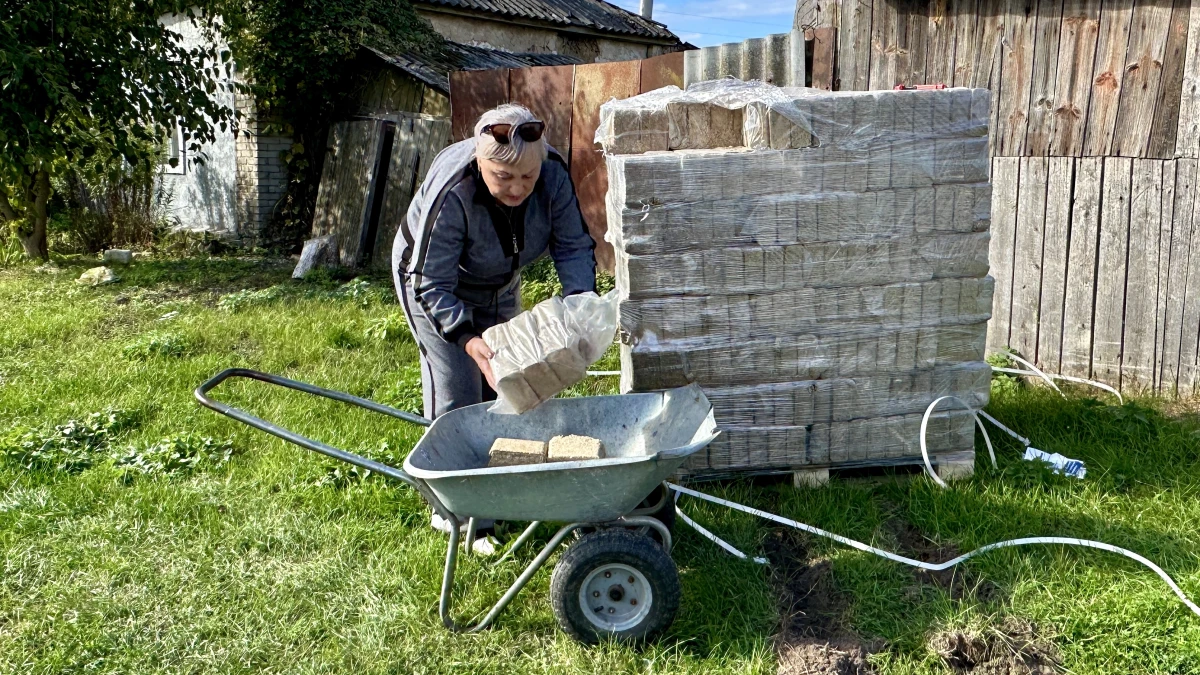
When there are no drones overhead, the village is quiet. Cars are rarely seen on its narrow dirt roads. Today, however, the rumble of a loader can be heard across the village. It is collecting heating briquettes from a truck on the outskirts and delivering them to residents’ yards.
Halyna and Mykola are waiting at the gate of their home for their delivery. In the past, the couple collected firewood themselves. With a pension of just UAH 3,700 (EUR 73), setting aside money to buy fuel was extremely difficult.

“We used to collect any dry branches that had fallen. But my husband is missing toes on his foot, and my eyesight is poor, so it was hard for us. Carrying the wood and chopping it was difficult,” Halyna says.
Together with the local authorities, we identified 66 households in Prudy to receive assistance. These include households with older people, people with disabilities, large families and internally displaced people.
“Firewood has become difficult to obtain because demand is high and prices have risen. Each household receives 3.5 tonnes of heating briquettes. People no longer have to search for somewhere to buy fuel or find someone to deliver it. With financial support from the US government, this assistance will help residents of Prudy keep their homes warm throughout the winter,” says Bohdan Kotelevets, Programme Officer at People in Need.

Yuliia and her husband lived with their two children in Shalyhyne, a village on the Russian border. As shelling intensified, the family had to leave. They first moved to Cherkasy and later to Prudy. When Yuliia talks about the home they left behind, tears come to her eyes.
“It’s very hard to leave behind everything you’ve worked for over the years. I have two children, aged seven and 12. They’re the reason I keep going,” Yuliia says.
The family was offered a small, old house where they could live rent-free. They made some cosmetic repairs and repaired the stove. They have now lived there for almost two years.
“Last winter, we probably used about two truckloads of firewood for heating. The house is old and has lots of gaps. We kept the stove going almost around the clock to make sure the children were warm. This is the first time we’ve received heating briquettes,” Yuliia says.

To ensure assistance was available in time for winter, our team and partners began preparing as early as summer. More than 3,000 households have received heating briquettes. In areas where firewood and coal are available locally, we provide cash assistance to help people buy the fuel they need.
Vitalii is an internally displaced person. He and his wife moved from Donetsk Oblast to Dnipropetrovsk Oblast. He registered to receive cash assistance from People in Need, with support from the European Union.
“I will use this money strictly for firewood. That way, I can save some of my pension for medicine, because I’m constantly ill. This assistance will really help us,” Vitalii says.

Olena still remembers the sound of cows crying out from thirst after being left behind in her village in Mykolaiv Oblast. When Russian forces advanced towards Stepova Dolyna, residents were forced to flee their homes. To prevent livestock from burning in their sheds, owners released their animals into the streets.
“There were so many cows. They had no water. They were crying out so loudly. It was terrifying. I don’t want to keep livestock anymore because I still haven’t recovered from the fear and pain of what happened,” Olena says.

She lost ten cows and 15 calves. After the village was liberated, she returned home. Electricity has been restored, but there is still no running water or gas.
“We have a wood-burning stove outside, and we cook on it. We heat food on a small gas burner. We grow vegetables and keep chickens. That’s how we get by,” Olena explains.
With support from people in the Czech Republic, Olena’s family received a kit to help them manage prolonged power cuts. It includes a portable gas stove with gas canisters, a power bank and insulated food containers.

As shelling and attacks on infrastructure intensify, more families are leaving frontline areas. Those who remain in their homes or relocate to other communities also need access to essential services and safe living conditions.
We will continue repairing damaged homes and water supply, sanitation and heating systems. We will also support social and educational facilities and temporary accommodation centres. This work will help people access essential services and prepare for winter.
- Support more than 40 social institutions and collective centres, as well as more than 20 Points of Invincibility.
- Repair more than 1,500 homes.
- Provide more than 10,000 households with heating briquettes or cash assistance to buy fuel.
- Repair more than 50 heating, water supply and wastewater systems.
- Support 20 educational facilities.

When the heating briquettes arrived in the yard, Yuliia’s younger son rushed to help her carry them into the shed. The assistance will help the family reduce heating costs and set aside money for other essentials. For Yuliia, the priority is making sure her children stay warm and safe. “You have to keep living. There’s a reason to. For the children,” she says.


