
Keeping Kherson moving: A social taxi provides a vital connection in a city under attack
Published: Sep 16, 2026 Reading time: 4 minutes Share: Share an articleIn Kherson, a simple trip to the hospital can be dangerous, as even something as mundane as public transport is under constant attack. For people living with disabilities, movement is doubly-difficult as buses aren't always adapted to their needs. That's why we support local organisations that help people reach essential services safely.
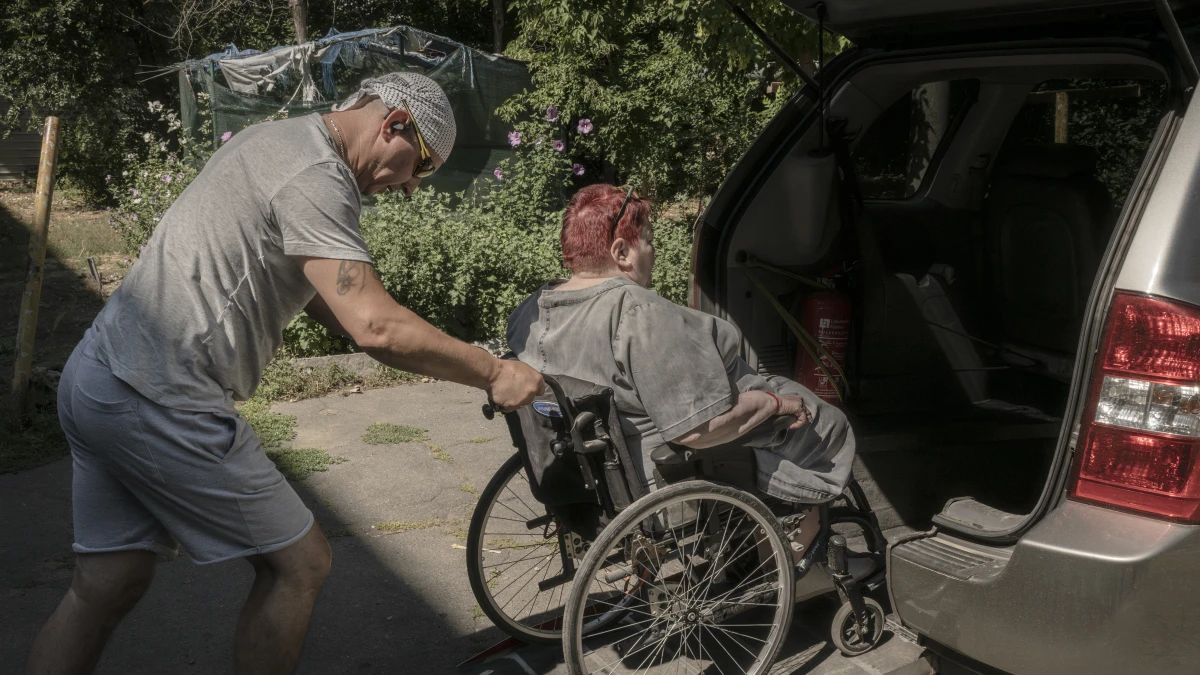
For Alina, getting home from hospital is not simply a matter of finding a ride.
She uses a wheelchair and lives in Kherson, where moving around the city has become increasingly difficult and dangerous. Before the vehicle carrying her leaves the hospital, the driver, Dima, switches on a drone detector fixed to the dashboard. Along the way, they pass roads covered by anti-drone nets and vehicles destroyed in attacks.

Dima works with Strong Because Free, a local organisation supported by our team at People in Need Ukraine. Strong Because Free provides a social taxi for people living with disabilities and other residents who face difficulties moving around the city.
Every day, drivers make around 15 to 20 trips, helping people get to hospitals, doctors, banks and other services. Their vehicles are adapted and equipped with ramps and dedicated spaces where wheelchairs can be safely secured.

For Alina, the service means something very practical: she can get the medical care she needs and make it home again.
In Kherson, even ordinary journeys require careful planning. Public transport continues to operate, but buses and other vehicles have repeatedly come under attack.
According to Vadim Melnyk, Kherson’s director of public transport, Russian forces have attacked more than 100 buses and trams since just the beginning of 2026, injuring six drivers. Oleksandr Prokudin, Head of the Kherson Regional Military Administration, has reported that 13 passengers have been killed and another 146 wounded since the beginning of the year.

In one recent attack, a drone dropped an explosive on a bus travelling between the Tavriiskyi and Korabel districts. Four passengers were killed and another four wounded. Despite the damage to the vehicle, the driver took the bus directly to hospital with the victims inside.
For people with disabilities and limited mobility, the options for getting around are even fewer. Public transport may not be accessible or suitable for their needs, while ordinary taxis can be expensive. Thus, a social taxi provides a way for residents who might otherwise struggle to leave their homes to reach healthcare and other essential services.
Kherson regional authorities have documented a sharp increase in Russian attacks during 2026. In April, authorities recorded almost 5,500 FPV drone attacks in a single week. By 17–23 August, the Kherson Regional Military Administration reported more than 6,400 FPV drone attacks and munition drops across the region, including 1,945 in Kherson city alone.

Behind these numbers are people trying to continue with everyday life: going to a medical appointment, getting essential documents, visiting a bank, or simply returning home.
According to Ihor Chornyi, head of Strong Because Free, six members of the organisation have been wounded. Six of its vehicles have been damaged and another two completely destroyed.
The social taxi is only one part of Strong Because Free’s support to people living in Kherson.
They also run a social centre where residents can meet and spend time together, operate a social barbershop, and support community activities, including a local gym for children.
When an air raid alert sounds, Ihor and his colleagues move into the corridor of their building because of the threat. Once the immediate danger passes, they return to their work.

Local organisations such as Strong Because Free play an essential role in ensuring assistance reaches those who need it. Their teams are part of the communities they support. They understand local needs and can respond quickly as circumstances change.
At People in Need, we support Strong Because Free in maintaining locally-led services for residents of Kherson, including those who may otherwise struggle to access essential support.
After leaving the hospital, Alina’s social taxi makes its way through Kherson towards her home in the Tavriiskyi district.
Her wheelchair is safely secured inside the adapted vehicle. On the dashboard, the drone detector remains switched on. Outside, anti-drone nets stretch above sections of the road, while damaged and burned vehicles are reminders of the risks people in the city face every day.
Tomorrow, Dima and his colleagues will make the journey again—taking another resident to a hospital, a doctor, a bank, or another place they need to reach. For people with disabilities and limited mobility, the social taxi helps ensure that the dangers of moving around the city do not completely cut them off from healthcare and other essential services.
And for Alina, its impact can be measured simply in that it enables her to reach the care she needs and return home safely.


