
A fifth winter of war: Preparing the people of Ukraine to withstand the cold
Published: Nov 23, 2026 Reading time: 5 minutes Share: Share an articleAs Russia continues attacking civilian infrastructure, including energy facilities, railways and bridges, vital services across Ukraine must endure immense strain. Without electricity and heating, homes can become uninhabitable during winter. We are providing equipment and supporting repairs to heating systems, so families can stay warm, and stay in their homes. Since the beginning of this year, we have helped keep 65 heating systems running, providing heat to more than 235,000 people.
Polina, from the village of Pidlypne in Sumy Oblast, is in the 10th grade at the local lyceum. She alternates between in-person and online study on a weekly basis. Because of the war, lessons have been moved to a shelter. However, the renovated space is too small to accommodate all the students, so the school has introduced a blended learning format.
“Before the renovation, we used to come down to shelter, but we didn’t have lessons here. We just sat here. Now, we have proper classes, sitting at desks. We study in alternating weeks. Our class comes in one week, and another class takes its turn the next week. That’s how we rotate,” Polina says.

To provide students with a comfortable place to learn, we renovated the shelter and installed a heating system. However, the school’s boilers were old and increasingly unreliable.
“We had to repair the solid-fuel boiler more and more often, and the repairs were becoming increasingly expensive. The gas boilers consumed a lot of gas, which was very costly for us. With the equipment we had, preparing for winter was a real challenge,” says Viktor Shcherbyna, the school principal.

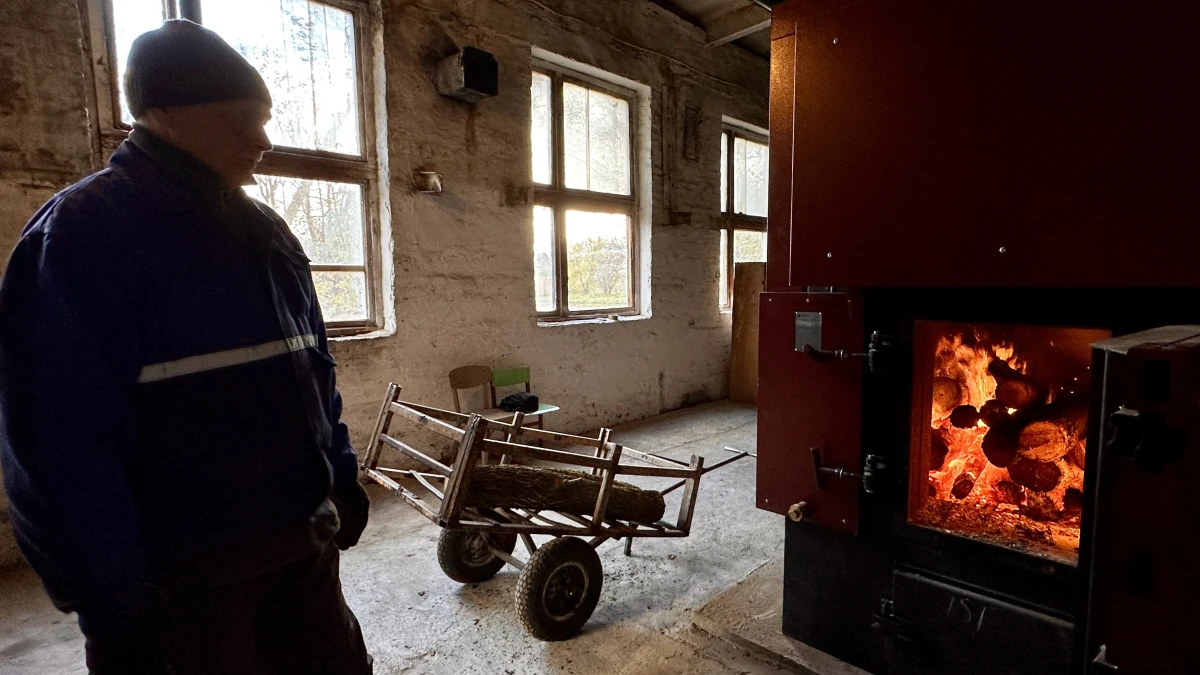
In summer, we installed solid-fuel boilers in the school’s boiler room. They were switched on when temperatures dropped. In addition, a large supply of firewood has been stored in the schoolyard and should last throughout the winter. Students and teachers can now continue their activities in a warm environment.
“It is critical to have in-person classes. Hearing the teacher in person, rather than through a computer screen, and talking to classmates makes a huge difference,” Viktor adds.
The town of Hlukhiv in Sumy Oblast is frequently attacked by Russian attacks. Drones and guided aerial bombs kill civilians and damage civilian infrastructure. When a drone struck a boiler plant, the heating supply to an entire neighbourhood was imperilled.

“This boiler plant serves 5,000 people. We received equipment from People in Need that helped us restore its operation,” says Kostiantyn Sierov, chief engineer at the local heating utility.
Around a third of the town’s residents have left because of constant attacks. For those who remain, access to water and heating is essential. To ensure supply, we provided a modular boiler house to the town after a drone damaged the facility that had previously supplied heat to residents.
“The modular boiler house was delivered in mid-September. It has already been connected and is heating seven apartment buildings, home to around 300 people. Thanks to your support, all our buildings are supplied with heat,” Kostiantyn Sierov adds.
Every morning, Ivan Ivanovych from the city of Konotop, Sumy Oblast, hurries to feed his animals. Near his apartment building, the 73-year-old has set up a small shed where he keeps rabbits, nutria, and chickens. “Sit properly,” he tells his favourite rabbit, Fedia, as he takes him out of his cage.
Ivan is retired but travels to Kyiv for shift work, a journey of more than 250 kilometres from Konotop. “The journey is long and difficult,” he says, explaining that Russian forces target passenger trains.
“You go to work without knowing whether you’ll make it home. It’s tough,” Ivan Ivanovych says.

When he returns home, his apartment is warm. The building has already been connected to the heating system. Previously, the boiler plant relied on boilers manufactured in 1993, which were operating at full capacity. We delivered one energy-efficient boiler to replace four old ones.
“In addition to the boiler, we received water storage tanks, a water treatment system, network pumps, and other equipment. We also received electrical protection equipment to protect the system from voltage fluctuations and ensure the boiler plant operates reliably,” says Yurii Yarmak, a maintenance supervisor at the heating utility.

Last year, Konotop, like many other parts of Ukraine, faced serious electricity supply problems.
“When temperatures drop below freezing and the equipment stops working, the entire heating system is at risk. We had to connect generators to keep the pumps running and prevent the pipes from bursting,” says Inna Verba, director of the municipal utility Teploharant.
Konotop has become a place of refuge for many people evacuated from communities affected by the war. Inna Verba also relocated from Sloviansk in Donetsk Oblast. The new equipment gives utility staff greater confidence that they can get through winter with fewer breakdowns.
Two boilers we provided to another boiler plant in the city have already been put to use.
“These boilers provide heat to several thousand residents, as well as a lyceum, a kindergarten and other public facilities. They are much more energy-efficient, which means we can save on gas,” Inna Verba adds.
In recent years, we have supported the restoration of heating systems in seven regions of Ukraine and in Kyiv. We have also providedHospitals, schools, and kindergartens equipment, alongside heating utilities.

Although Ivan Ivanovych’s apartment is warm, he still has plenty to worry about. This will be Ukraine’s fifth winter since Russia launched its full-scale invasion. People have learned to manage disruptions to essential services, from using power stations and power banks to planning their daily lives without electricity or water. But this is an exhausting way to live.
“Like other Ukrainians, I worry about how we’ll get through the winter. Will these attacks ever stop?” Ivan Ivanovych says.


